LITTLE LEARNERS,
BIG PREPAREDNESS
A Complete Emergency Readiness Series for Families with Children Ages 3 to 5
Series Introduction • 8 pieces total • Start here
• • •
There is a question underneath every emergency preparedness guide ever written, and it almost never gets asked directly: who is this actually for?
Most preparedness content is written for capable adults — people who can read a FEMA checklist, compare water filter specifications, and map a primary and secondary evacuation route in an afternoon. That content is valuable. But it leaves an enormous gap, because capable adults are not the most vulnerable people in a household during an emergency. Small children are.
A three-year-old cannot read a checklist. A four-year-old cannot assess structural damage. A five-year-old cannot navigate an evacuation route they have never practiced. But all three of them can learn — in ways that are developmentally appropriate, emotionally safe, and deeply effective — what to do when the lights go out, where to go when the alarm sounds, and who to find when they need help.
• • •
That is what this series is for.
Little Learners, Big Preparedness is not a disaster survival manual for preschoolers. It is a guide for the adults who love them — written to help those adults give small children the one gift that no emergency can take away: the calm, settled confidence of knowing what to do.
What This Series Covers
This series is organized into eight standalone pieces — a series introduction and seven full blog posts — each focused on a distinct dimension of emergency preparedness for children ages three to five. They can be read in order as a complete curriculum, or individually as standalone references on specific topics.
The 8 Pieces in This Series
Introduction — What this series is, who it’s for, and how to use it (you are here)
Post 1 — The Foundation: Why preparing your preschooler is one of the most loving things you’ll do
Post 2 — How They Learn: What every parent needs to know about how a 3-to-5-year-old actually learns
Post 3 — What Ready Looks Like: 13 things a prepared five-year-old knows — and how to get there
Post 4 — The Six Core Activities: Games that teach emergency skills without a single scary moment
Post 5 — The Full A-to-Z Curriculum: All 26 letters taught for ages 3 to 5 with full lesson plans
Post 6 — The Hard Conversations: When your preschooler asks the questions you weren’t ready for
Post 7 — The Year-Long Plan: A gentle 12-month preparedness plan for families with young children
• • •
You do not need to read everything before you begin. If you have a specific need right now — your child just asked a hard question, or you want to start with a single activity this weekend — go directly to the post that addresses it. If you want to understand the full picture first, start with Post 1 and work forward.
What matters is not the order. What matters is that you begin.
Who This Series Is For
This series is written for anyone who spends meaningful time with children between the ages of three and five and wants to give those children a foundation of calm, practical emergency readiness. That includes:
- Parents and stepparents of children ages 3 to 5
- Grandparents and extended family members who provide regular care
- Foster and adoptive parents, with specific attention to children who may carry additional trauma sensitivity
- Daycare providers, preschool teachers, and early childhood educators
- Neighbors, family friends, and godparents who want to be a preparedness resource for children they love
- Emergency management professionals looking for family-facing outreach content for this age group
- Anyone who works with young children and has ever wondered: what would happen to this child in an emergency.
You do not need any prior knowledge of emergency preparedness to use this series. Every concept is explained from the ground up. What you do need is time, patience, and the willingness to repeat yourself — which, if you spend any time at all with a preschooler, you already have in abundance.
The Philosophy Behind This Series
Every piece of content in this series rests on three core beliefs about young children and emergency preparedness. Understanding these beliefs will help you use the content more effectively.
Belief 1: Familiarity Is Safety
Young children are alarmed by the unfamiliar and calmed by the familiar. The goal of early preparedness education is not to teach children to manage emergencies — it is to make emergency-related concepts, objects, and routines familiar before an emergency occurs. A child who has found the flashlight twenty times in a game finds it automatically the twenty-first time, when the lights are actually out. Familiarity is the mechanism. Repetition is the method.
Belief 2: Tone Is the Curriculum
A preschooler will not remember the content of a preparedness conversation a week later. They will remember how the adult felt during it. A parent who approaches the flashlight game with calm matter-of-factness is teaching their child that emergency preparedness is ordinary, manageable, and not frightening. That emotional encoding outlasts any specific fact. Throughout this series, tone — the emotional register in which preparedness is taught — is treated as the most important curriculum variable, not an afterthought.
Belief 3: Caring Is the Motivation
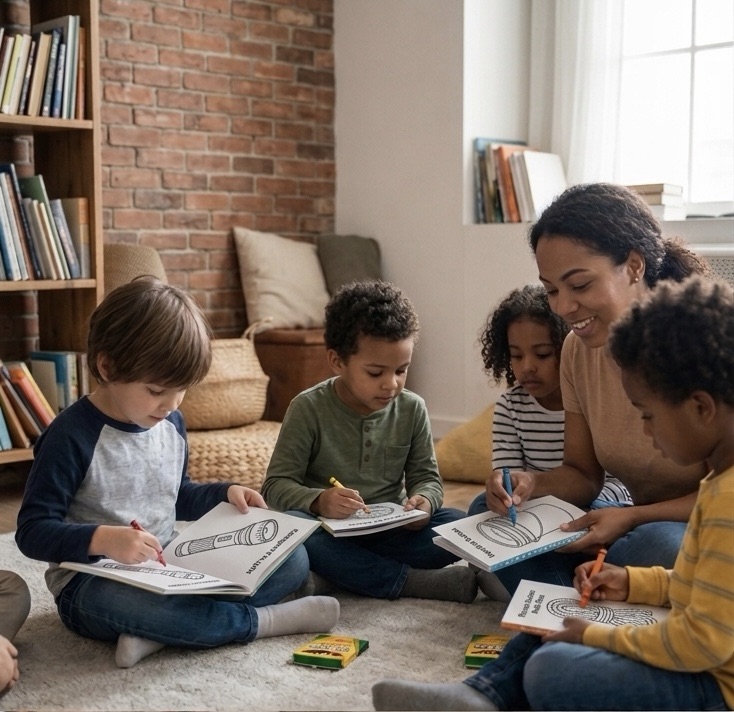
Emergency preparedness for young children is not about fear, self-sufficiency, or worst-case-scenario thinking. It is about caring — for the child, for the family, for the neighbors who may need help, for the community that becomes stronger when its smallest members are also its most prepared. Every lesson in this series is framed as an act of caring, because that is what it is. The parent who sits down with a coloring page and talks about what a flashlight does is not preparing for disaster. They are loving their child in one of the most practical and lasting ways available to them.
Preparedness is not a project you complete. It is a way of being a family — patient, attentive, and ready for whatever comes.
How to Use This Series
There is no single right way to work through this content. Here are three proven approaches depending on your starting point and how much time you have:
If You Are Starting From Zero
Read Post 1 first. Then Post 2. Then begin the six core activities from Post 4 — pick one this week, just one, and do it with your child. Do not wait until you have read everything to begin. The value of this series is in the doing, not the reading.
If You Have Some Preparedness in Place Already
Go directly to Post 3 and assess where your child currently lands against the 13 readiness outcomes. Then use Post 5 to fill in the gaps by working through specific letters of the A-to-Z curriculum. Use Post 7 as a maintenance framework to ensure what you have built gets reviewed and refreshed.
If Your Child Has Just Asked a Hard Question
Go directly to Post 6. It addresses every difficult question a preschooler is likely to ask about emergencies, with specific suggested language and guidance on what not to say. Come back to the foundation posts when the immediate moment has passed.
A Note on Pace: This series contains more content than any family needs in a single sitting. It is designed to be returned to over months and years. Bookmark it. Come back to it when a storm passes through your area and your child asks questions. Come back when you restock your kit. Come back a year from now and notice how much more your child understands. Preparedness is a practice, not a project.
A Word About Fear
If you have hesitated to teach your child about emergencies because you worry it will frighten them — this section is for you.
The fear you are trying to protect your child from does not come from preparedness education. It comes from encountering an unfamiliar, confusing, threatening situation without any framework for understanding it. A child who has never heard the word ‘tornado’ and suddenly hears a siren while the sky turns green is experiencing pure, unmitigated fear. A child who has colored the tornado page, who has practiced going to the interior hallway, and who has heard a calm parent say ‘if we ever hear that sound, here is exactly what we do’ — that child still feels fear when the siren sounds, but it is fear with a container. They know what the sound is. They know what to do. They know their parent thought ahead.
That containment does not eliminate fear. But it transforms it from something that overwhelms into something that can be managed. And the ability to manage fear — to feel afraid and still act — is one of the most important capacities a human being can develop. We begin building it at three years old, one coloring page at a time.
Start where you are. Use what you have. Go at whatever pace your child and your family can sustain. And know that every single conversation you have about the flashlight, the go-bag, or the meeting spot is doing something real and lasting for a small person who trusts you completely.
That trust is the most important preparedness resource you have. Use it well.
Begin Here: Your First Step
Before you read another word of this series, do one thing. Right now, or tonight, or this weekend:
- Find your family’s flashlight.
- Make sure it works.
- Show your child where it lives.
- Ask them to find it with their eyes closed.
- Tell them: ‘This is our emergency flashlight. We always know where it is.
That is it. That is the beginning. Everything else in this series builds from that one moment of calm, practical, loving attention.
Welcome to the series. Let’s begin.
Tags: emergency preparedness for preschoolers, little learners big preparedness, ages 3-5 safety, family preparedness series, young children emergency readiness, ABC preparedness, child safety, disaster readiness for families
Series: Little Learners, Big Preparedness • Series Introduction
Series Introduction • Approx. 1,400 words • Audience: All caregivers of children ages 3–5
• • •
 Homeland Urban Buckets (HUB)