Why Preparing Your Preschooler Is One of the Most Loving Things You’ll Ever Do
Little Learners, Big Preparedness Series
Approx. 15-minute read • No prior preparedness knowledge required
Every parent has a version of the same imagined moment: something goes wrong, and their child is either okay or not okay. The house fills with smoke. The lights go out and don’t come back on. The weather turns suddenly and violently wrong. A crowd surges and a small hand slips from a larger one.
In that imagined moment, every parent wants the same thing: for their child to know what to do.
What very few parents have thought through is the question that follows: how does a child come to know what to do? Not in the abstract — but concretely, practically, in the specific body of a specific three-year-old or four-year-old or five-year-old who has never been through anything like it before?
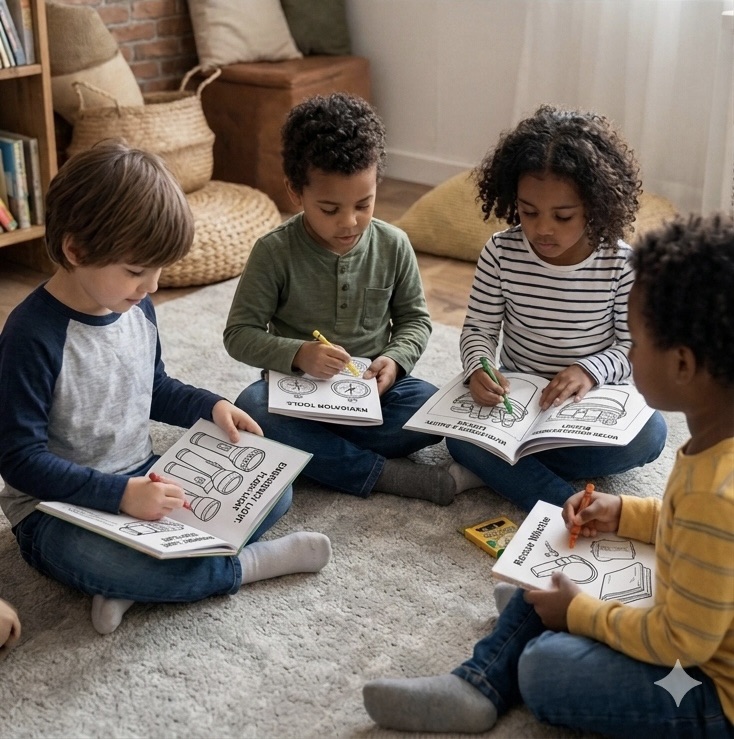
The answer is the same as the answer to every other developmental question about young children. They learn through repetition. Through play. Through the calm, patient attention of a trusted adult who has decided this is worth teaching. They learn through a coloring book and a flashlight game and a family meeting spot practiced on a lazy Saturday morning when nothing at all is wrong.
They learn, in other words, the same way they learn everything — except that most of us never think to teach them this particular thing.
This post makes the case for why you should. Not from fear. Not from worst-case-scenario thinking. But from the same deep love that makes you buckle a car seat, hold a hand at a crosswalk, and read the same bedtime story seven nights in a row because your child needs to hear it again.
Preparing a young child for emergencies is not about making them afraid of the world. It is about making them fluent in the one language that matters most when something goes wrong: the language of calm, purposeful action.
The Gap Most Families Don’t Know They Have
Ask most parents of young children whether they have an emergency plan and they will say yes. They have smoke detectors. They have a first aid kit somewhere in a cabinet. They have thought, vaguely, about what they would do if the power went out for more than a few hours.
This is the gap. Not a gap in supplies or equipment, but a gap in inclusion. The youngest, most vulnerable members of most households are also the members most completely excluded from emergency planning. They are the passengers — the people things happen to — rather than participants in the family’s response.
That exclusion has real costs. Research from the National Child Traumatic Stress Network consistently shows that children who have no framework for understanding an emergency event — no vocabulary for what is happening, no role to play, no sense that the adults around them anticipated this — show significantly higher rates of post-disaster trauma, anxiety, and sleep disruption than children who were included in preparedness education before the event occurred.
The children who do best after emergencies are not the ones whose families had the most supplies. They are the ones who felt, before, during, and after, that their family knew what to do. That settledness — that basic orientation of ‘we have a plan and I am part of it’ — is a profound protective factor that no amount of bottled water can replicate.
And it is entirely achievable. With a coloring book, a flashlight, a meeting spot, and about ten minutes a week.
The Research: Children with a defined role in a family emergency plan show measurably lower rates of post-disaster anxiety than children who were unaware a plan existed. Inclusion is protective. Exclusion, however well-intentioned, leaves children more vulnerable.
What We Are Actually Teaching
When we sit down with a preschooler and a coloring page and begin talking about what a flashlight is for, we are teaching several things simultaneously — and only one of them is information about flashlights.
We Are Teaching That the World Is Manageable
Every emergency preparedness lesson carries an implicit message: hard things happen, and our family has thought about what to do. That message, absorbed through the emotional register of a calm, unhurried adult, is one of the most powerful contributions to a child’s developing sense of security. It says: the world has difficult moments, and we are the kind of family that prepares for them. Not because we are afraid, but because we are thoughtful.
We Are Teaching Competence
A five-year-old who can find the flashlight, say their home address, and navigate to the family meeting spot possesses real, functional competence. They are not pretending to be capable — they are actually capable, within the realistic scope of what a five-year-old can do. That genuine competence builds self-efficacy: the belief, grounded in actual experience, that I can handle difficult things. Self-efficacy is one of the most protective psychological factors researchers have identified for both children and adults facing adversity.
We Are Teaching Caring as a Practice
When we teach the N lesson — N is for Neighbor — and we ask our child who in our neighborhood might need help during a storm, we are doing something far larger than preparedness education. We are teaching a child to look outward. To extend the circle of their concern beyond themselves and their immediate family to the vulnerable people around them. That is a moral education, delivered through the vehicle of a coloring page, with permanent effects on the kind of person a child becomes.
We Are Teaching Calm as a Choice
The three slow breaths technique — introduced as the Z lesson, Zero Panic — is not a cute addition to the curriculum. It is a physiological self-regulation skill that works for children, adolescents, and adults equally well. A child who has practiced intentional breathing during low-stakes moments has a genuine tool available to them in high-stakes ones. Teaching calm as a practiced, repeatable choice rather than a personality trait is one of the most enduring gifts this curriculum offers.
When a child learns to find the flashlight, they learn more than the location of a flashlight. They learn that they are the kind of person who knows where the flashlight is. That identity is the real curriculum.
The Objections Parents Raise — And the Responses
Most parents who hear about early childhood emergency preparedness education have one or more of the following concerns. They are worth addressing directly.
‘Won’t this frighten my child?’
This is the most common concern, and it reflects a misunderstanding about where children’s fear actually comes from. Children are not frightened by knowledge — they are frightened by the unfamiliar. A preschooler who has colored the tornado page, who has practiced going to the interior hallway, who has heard a calm parent explain what a tornado siren means, is less frightened when a real siren sounds than a preschooler who has never heard the word tornado and suddenly encounters one. Preparedness education does not introduce fear. It provides a container for fear that would arrive anyway.
‘My child is too young to understand.’
At age three, the goal is not understanding — it is familiarity. A three-year-old does not need to understand why we store water to benefit from knowing that we do, and seeing where it lives. They do not need to understand what a tornado is to know that when a certain sound happens, we go to the hallway and sit with our back against the wall. Understanding follows familiarity. We plant the seed at three; it becomes comprehension at five and genuine competence at eight.
‘I don’t know enough about emergency preparedness to teach it.’
You know enough to find a flashlight. You know enough to identify a meeting spot outside your home. You know enough to say your phone number out loud with your child until they can say it back. That is genuinely enough to begin. This series will walk you through every concept, every activity, and every conversation. You do not need to be an expert. You need to be present, patient, and willing to repeat yourself.
‘We don’t really have emergencies where we live.’
Every community has power outages. Every home has fire risk. Every family includes human beings who can experience medical emergencies. The most universal emergency scenarios — a power outage lasting more than a few hours, a smoke alarm triggering in the night, a child separated from a parent in a public place — are not regional. They are simply human. And a child who knows their name, their address, and one phone number is better equipped for all of them, regardless of geography.
What Preparedness Education Is Not
Because misunderstandings are common, it is worth being explicit about what this curriculum does not involve:
• It is not survivalism. We are not teaching preschoolers to build shelters or purify water from streams.
• It is not fear-mongering. Every lesson is framed in calm, matter-of-fact, age-appropriate language.
• It is not a drill program. There are no sirens, no timed evacuations, no scenarios designed to simulate emergency stress.
• It is not a replacement for adult responsibility. Children are participants in the family plan, not the people responsible for executing it.
• It is not a one-time lesson. It is a practice — repeated, low-key, woven into ordinary family life over months and years.
• It is not complicated. The most powerful things in this curriculum are also the simplest: find the flashlight, know the meeting spot, practice three slow breaths.
What it is, at its core, is a form of love. The specific, practical, forward-looking kind of love that says: I have thought about what might be hard for you, and I have done something about it. I have made you a little more ready, a little more confident, and a little more capable of handling the unexpected world you are growing up in.
That is the foundation. Everything else in this series builds from here.
How to Read the Rest of This Series
This post has made the case for why. The remaining six posts in this series address the how — in specific, practical, fully expandable detail. Here is a brief map of what is ahead:
• Post 2 is about the learning science. Before you teach, understand how your child actually absorbs and retains information at this developmental stage. It will transform how you approach every activity.
• Post 3 is about outcomes. What does a genuinely prepared five-year-old look like? What can you realistically expect, and how do you know when you’ve gotten there?
• Post 4 is the activities. Six core exercises, each expanded in full detail, with variations by age and guidance for when a child resists.
• Post 5 is the full curriculum. Every letter, fully taught, with a lesson plan, a conversation, a play activity, and a real-world connection for each one.
• Post 6 is the hard conversations. What to say when a child asks the questions that catch you off guard. Specific language, what to avoid, and how to recognize when a child needs more support than preparedness education can provide.
• Post 7 is the year-long plan. Twelve months, month by month, in full detail — with activities, supplies, milestones, and reflection prompts for every step.
You are already doing something important by reading this. The next step is simple. Find your flashlight. Make sure it works. Show your child where it lives.
Everything else follows from that.
Tags: emergency preparedness foundation, why prepare young children, preschooler safety, family emergency plan with kids, ages 3-5 preparedness, child development and emergency readiness, loving preparedness
Series: Little Learners, Big Preparedness • Post 1 of 7: The Foundation
Post 1 of 7 • Approx. 2,200 words • Audience: Parents and caregivers of children ages 3–5
Little Learners, Big Preparedness • Post 1 of 7: The Foundation
 Homeland Urban Buckets (HUB)