Return HOME
What Every Caregiver Needs to Know About How a 3-to-5-Year-Old Actually Learns
Little Learners, Big Preparedness Series
Approx. 15-minute read • Developmental science made practical for parents
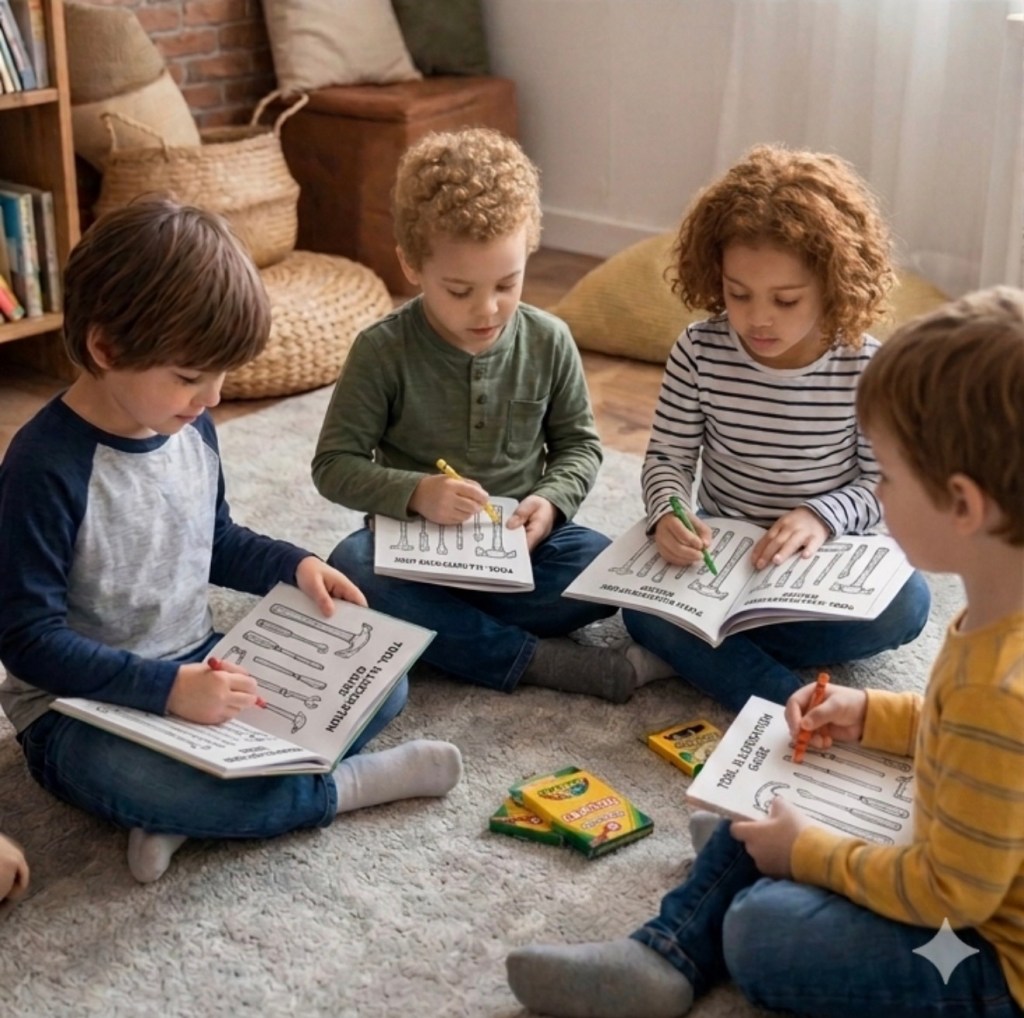
Before you teach a single preparedness concept to a young child, the most valuable thing you can do is understand something about how their brain actually works. Not at a textbook level — but at the level of practical, daily application. Why does repetition work when explanation doesn’t? Why does a five-minute game stick when a ten-minute conversation evaporates? Why does your tone matter more than your words?
The answers to these questions are not complicated, but they are specific. And they will change how you approach every single activity in this series — making everything you do more effective, less frustrating, and more enjoyable for both you and your child.
This post covers four core developmental principles that govern how children ages three to five learn and retain information. Each principle is explained, then applied directly to emergency preparedness education. By the end, you will understand not just what to teach your child, but how to teach it in a way that actually lasts.
The gap between knowing what to teach and knowing how to teach it is the gap between a preparedness lesson that disappears by bedtime and one that stays with a child for years.
Principle 1: Concrete Beats Abstract, Every Time
The prefrontal cortex — the part of the brain responsible for abstract reasoning, hypothetical thinking, and complex planning — is not fully developed until the mid-twenties. In a three-to-five-year-old, it is in the very earliest stages of development. This is not a deficit. It is a developmental reality with direct implications for how you teach.
A three-year-old cannot meaningfully engage with the concept of ’emergency preparedness.’ They cannot picture a hypothetical scenario, assess its probability, and identify the optimal response. What they can do — with extraordinary efficiency — is learn the location, appearance, feel, and function of a specific, physical object. The flashlight. The bucket. The meeting spot under the oak tree.
Every abstract concept in this curriculum must be anchored to something concrete. Not ‘we have a plan for emergencies’ but ‘our plan says we meet at the oak tree on.’ Not ‘we store water in case we need it’ but ‘these three jugs are our emergency water, and they live on this shelf.’ Not ‘you have a role in our emergency plan’ but ‘your job is to grab your blue backpack and come to the front door.’
The coloring book format works precisely because of this principle. A child who spends twenty minutes coloring a detailed illustration of a flashlight — its lens, its grip, its beam of light — has built a richer, more durable mental representation of that object than a child who merely heard it mentioned. The hand encodes what the mind alone would forget.
In Practice: Before introducing any preparedness concept, ask yourself: what is the physical, touchable, locatable version of this concept? Start there. The abstraction can come later, when the concrete foundation is solid.
This principle also explains why field trips are so effective at this age. Walking to the meeting spot is more powerful than describing it. Opening the emergency kit and taking things out is more powerful than listing its contents. Holding the hand-crank radio and hearing the sound it makes is more powerful than explaining what it does. Whenever possible, let the child’s hands lead.
Principle 2: Repetition Is Not Boring — It Is How Learning Happens
Adults experience repetition as monotony. Young children experience it as mastery — and they actively seek it. The toddler who demands the same story seven nights in a row is not expressing limited imagination. They are doing the essential work of consolidating new information into long-term memory. Each repetition confirms the pattern, fills in a detail, builds confidence. By the seventh reading, the child is no longer listening to learn. They are listening to confirm that they already know.
This is the mechanism behind all early preparedness education: repetition until a concept becomes automatic. ‘Where is the flashlight?’ is not a tedious question the fourteenth time you ask it. It is the fourteenth step toward a child who can answer without thinking — which is exactly what you want when the lights go out at 2am and thinking is the last thing anyone is doing well.
Automaticity — the ability to perform a skill without conscious effort — is the gold standard of emergency preparedness training at any age. For adults, it is built through drills and practice runs. For young children, it is built through play-based repetition in low-stakes moments. The flashlight game, played twenty times across twelve months, produces the same automaticity as an adult’s drill — calibrated to a child’s developmental stage.
The practical implication: do not worry about repeating yourself. Worry about varying the format of the repetition so that your child stays engaged. Ask the question at dinner, in the car, at bedtime, during a walk. Make it a game sometimes, a casual mention other times, a coloring activity another time. The content stays the same. The vehicle changes. And the encoding deepens with every encounter.
The parent who asks ‘where is our flashlight?’ for the twentieth time is not being repetitive. They are building a skill that works in the dark.
A note on patience: you will repeat yourself far more than you expect before a young child can recall something reliably. This is normal. It is not a reflection of your child’s intelligence or your teaching effectiveness. It is simply how declarative memory works in the preschool years. Stay the course.
Principle 3: Emotional Tone Is Absorbed Before Content
This is the principle that parents most frequently underestimate, and it may be the most important one on this list.
Young children are exquisitely sensitive to the emotional states of their caregivers. Before they have language to describe what they are picking up, they are reading facial expressions, vocal tone, body tension, and breathing rate with a precision that adults largely lose as they mature. A parent who is anxious about emergency scenarios will communicate that anxiety to their child more effectively through their non-verbal cues than through any words they use — even if those words are technically reassuring.
Conversely, a parent who approaches the flashlight game with genuine calm matter-of-factness — the same low-key energy they bring to explaining how to sort laundry or where the recycling goes — sends an equally powerful message: this is ordinary. This is manageable. Our family does this because we are thoughtful, not because we are afraid.
The tone is the curriculum. The content, at this developmental stage, is almost secondary. A child who absorbs the emotional message that emergencies are manageable and that their family has thought ahead will be less traumatized by a real emergency than a child who has memorized every item in the kit but absorbed the message that emergencies are terrifying.
Practical guidance: Before you begin any preparedness activity with your child, check your own emotional state. If you are anxious about something in the news, worried about a real emergency risk in your area, or carrying stress from the day, take your own three slow breaths first. The regulation you practice on yourself directly protects your child.
The Test: If you would not deliver the preparedness lesson in the same tone you use to talk about what’s for dinner, slow down. Reset. Your child is reading your body before they hear your words.
Principle 4: Play Is the Learning Vehicle, Not a Shortcut
For children between the ages of three and five, play is not the opposite of learning. It is the primary medium of learning. This is not a pedagogical preference or an educational philosophy — it is a neurological fact. The brain states associated with engaged, joyful play are the brain states most conducive to memory formation, skill acquisition, and the development of executive function.
This means that a five-minute game of ‘flashlight find’ is not a fun way to teach preparedness — it is the most effective way to teach preparedness to a preschooler. A coloring activity is not a compromise for children too young for real instruction — it is real instruction, delivered in the format most appropriate for the developing brain. A role-playing game in which a stuffed animal gets a ‘boo-boo’ and needs the ice pack from the emergency kit is not play-acting — it is deliberate practice in the exact form that works.
Parents who feel guilty about making preparedness ‘too fun,’ or who wonder whether they should be having more serious conversations instead, can release that concern entirely. The fun is the point. The engagement is the delivery mechanism. The joy is what makes the lesson stick.
This principle also has a corollary: when a child is not engaged, the lesson is not landing. If your child is distracted, resistant, or bored during a preparedness activity, the appropriate response is not to push through — it is to stop, find a different format, or come back at a different time. A disengaged child is not storing information. They are enduring the lesson. And the emotional memory of enduring is not the emotional memory you want attached to emergency preparedness.
Making Any Preparedness Concept More Play-Based
Turn it into a timed game: ‘Can you find the flashlight in 30 seconds?’
Turn it into a role play: ‘Let’s pretend the lights just went out. What do we do first?’
Turn it into a story: ‘Once upon a time, a family had a very special bucket…’
Turn it into a physical journey: walk to the meeting spot, touch the emergency kit, open the water jug
Turn it into a quiz: ‘I’m going to say something wrong and you correct me. Ready? W is for… window!’
Turn it into their job: give them a real, specific task and let them own it completely
Turn it into a song: set any preparedness concept to a familiar tune — the sillier, the better
Putting the Principles Together: What a Good Lesson Looks Like
A preparedness lesson for a three-to-five-year-old that applies all four principles looks something like this:
You are in the kitchen making dinner. Your child is underfoot. You say, casually: ‘Hey, I have a question for you. Where is our flashlight?’ They say they don’t know. You say: ‘Want to go find it together?’ You walk with them to wherever the flashlight lives. You let them pick it up and turn it on. You say: ‘This is our emergency flashlight. It lives right here. Can you remember that?’ They say yes. You say: ‘I bet you can find it faster next time. We’ll check tomorrow.’
That is it. Three minutes. Concrete object, physically located. Emotional tone: calm and casual. A small element of game embedded in the challenge of ‘faster next time.’ And the promise of repetition tomorrow.
That three-minute interaction, repeated twenty times across three months, produces a child who can find the flashlight in the dark without thinking. That is a real preparedness outcome. And it took, in total, perhaps sixty minutes of your time — spread across three months, embedded in the ordinary texture of family life.
The principles are not complicated to apply. They just require consistent, patient attention to the ordinary moments that are already there.
Return HOME
Tags: how preschoolers learn, child development and preparedness, concrete learning ages 3-5, repetition in early childhood, emotional tone and children, play-based learning emergency preparedness
Series: Little Learners, Big Preparedness • Post 2 of 7: How They Learn
Post 2 of 7 • Approx. 2,100 words • Audience: Parents and caregivers of children ages 3–5

