Return HOME
13 Things a Prepared Five-Year-Old Knows — And How to Get There
Little Learners, Big Preparedness Series
Approx. 15-minute read • Practical milestones by age 3, 4, and 5
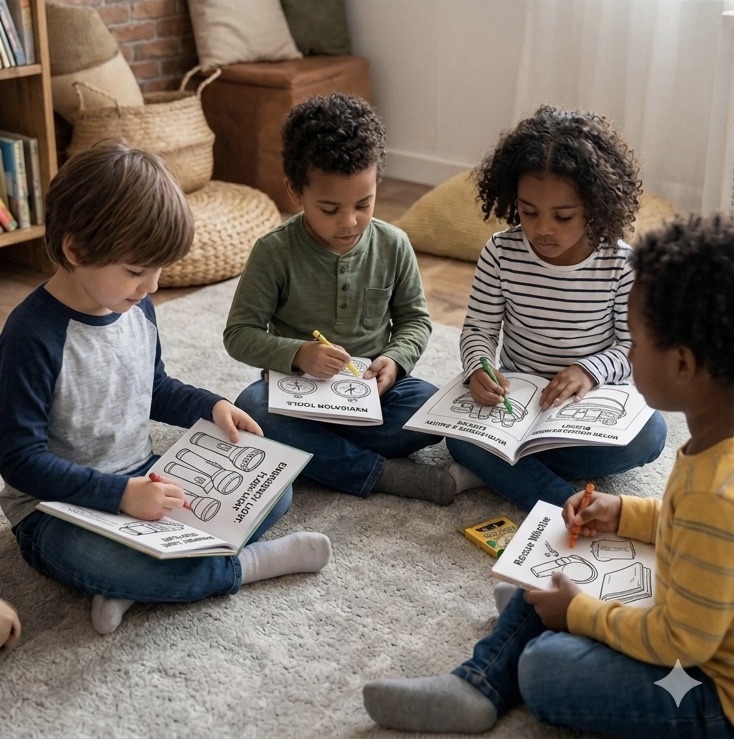
One of the most common questions parents ask about early childhood preparedness is a simple one: how do I know when we’ve gotten there? How do I know if my child is actually prepared, or if we are just going through motions?
It is a fair question, and it deserves a specific answer. Not ‘your child should have a general sense of emergency concepts’ — but a concrete, observable list of what a genuinely prepared child at this age actually knows and can do.
This post provides that list. Thirteen specific, realistic, measurable outcomes for children who have completed the ABCs of Being Prepared curriculum — along with a breakdown of what to expect at ages three, four, and five, and practical guidance on how to move a child from where they are now to where you want them to be.
Read through the outcomes first. Then assess where your child currently stands against each one. The gaps you identify are the starting points for your preparedness work.
Preparedness is not binary — not prepared or unprepared. It is a continuum, and every step forward along it makes a child safer, more confident, and more capable of handling difficulty.
The 13 Outcomes — In Full Detail
Outcome 1: They Know Their Full Name
Not just their first name — their full first and last name, spoken clearly enough for an unfamiliar adult to understand. This is the most fundamental piece of identifying information a separated child can provide. It sounds obvious, but many children at age three can only reliably produce their first name, and many four-year-olds cannot say their last name clearly to a stranger.
Age 3: Can say first name clearly. May not reliably produce last name.
Age 4: Can say full name clearly in a low-stress context. May stumble under stress.
Age 5: Can say full name clearly to an unfamiliar adult in any context, including stressful ones.
How to get there: Practice at low-stakes moments. ‘What’s your name?’ is a game, not an interrogation. Ask it at the dinner table, in the car, during bath time. Make it a call-and-response. Celebrate precision.
Outcome 2: They Know Their Home Address
At minimum: the street name and town. Ideally: the house number as well. A child who knows their address can be returned home even if they cannot describe their parents.
Age 3: Knows the name of their street or neighborhood. May know the town.
Age 4: Can say street name and town reliably. House number emerging.
Age 5: Can say full address including house number, street, and town.
How to get there: Say it out loud together on walks. Point to the house number on the door every time you arrive home. Make it part of the daily physical ritual of coming home.
Outcome 3: They Know One Phone Number by Heart
One parent’s or caregiver’s mobile number, memorized to the point where they can recite it under stress to an unfamiliar adult. This is harder than it sounds and requires more repetition than most parents expect.
Age 3: Beginning to recognize digits in the number. Cannot reliably recite it.
Age 4: Can recite the number in a calm context with prompting. May not produce it independently.
Age 5: Can recite the full number independently in any context.
How to get there: Sing it. Set it to a familiar tune. Practice it in the car. Quiz it at random. It takes dozens of repetitions — plan for that.
Outcome 4: They Recognize Emergency Sounds and Know the Response
The smoke alarm, the tornado siren, and the carbon monoxide alarm each have a specific sound and a specific correct response. A prepared child can name the sound and state the response — not perfectly, but reliably.
Smoke alarm response: Get low, get out, stay out, meet at the spot.
Tornado siren response: Go inside, go to the interior room, get low, find a grown-up.
Carbon monoxide alarm response: Get everyone out, go outside, call for help.
Age 3: Knows the smoke alarm sound and the basic response (out of the house).
Age 4: Knows smoke alarm and tornado siren responses clearly.
Age 5: Knows all three alarm responses and can distinguish between them.
How to get there: Play the sound for them on your phone and practice the response. Never skip the discussion after a real smoke alarm triggers — even a false one is a teaching moment.
Outcome 5: They Can Find and Operate the Family Flashlight
Not just know that a flashlight exists — physically navigate to it, pick it up, and turn it on without adult assistance.
Age 3: Knows the general location with prompting. Can turn it on with help.
Age 4: Can find it independently in a calm context. Can turn it on reliably.
Age 5: Can find and operate it independently in a low-light or dark context.
How to get there: The flashlight find game, repeated until it is automatic. See Post 4 for full instructions.
Outcome 6: They Know the Family Meeting Spot and Can Navigate There
A specific outdoor location — not a vague ‘outside’ — that the child can name and physically navigate to from the front door of the home.
Age 3: Knows the name of the spot and can be walked there.
Age 4: Can navigate to the spot from the front door with a verbal reminder.
Age 5: Can navigate to the spot independently when directed.
How to get there: Walk there. Walk there again. Make it a race. Walk there in different weather. The navigation becomes automatic only through physical repetition.
Outcome 7: They Know What a Go-Bag Is and Where Theirs Lives
A child who has packed their own go-bag, whose name is on it, and who knows exactly where it is stored will reach for it instinctively.
Age 3: Knows the go-bag exists and where it lives. Has seen inside it.
Age 4: Can retrieve their go-bag independently when directed.
Age 5: Can state what is inside their go-bag and why each item is there.
Outcome 8: They Understand Why Water Is Stored
Not the technical details — simply: water is stored because sometimes we can’t get water from the tap, and we always want to have enough.
Age 3: Knows water is in the kit. May not know why.
Age 4: Can explain simply: ‘It’s for emergencies, when we can’t get water.’
Age 5: Knows how many jugs and roughly how many days they last.
Outcome 9: They Know Two Trusted Adults Outside the Home
Not just ‘firefighters’ or ‘police’ in the abstract — specific named individuals: a neighbor, a teacher, a grandparent, a family friend who they have met, whose name they know, and whom they understand they can approach for help.
How to get there: Make introductions. Walk the block. Point people out. Name them. ‘If you ever need help and I’m not there, Mrs. Henderson at the yellow house is someone you can go to.’ Make it specific and human.
Outcome 10: They Can Say ‘I Need Help’ to a Stranger
Many children are so thoroughly taught ‘don’t talk to strangers’ that they freeze when they genuinely need to approach an unfamiliar adult for help. A prepared child knows that in an emergency, approaching a trusted-looking adult — a store employee, a teacher, a parent with children, a uniformed worker — and saying ‘I need help, my name is ___ and my number is ___’ is exactly the right thing to do.
How to get there: Role-play it. Practice the script. Clarify who ‘safe strangers’ are. The child who has practiced this feels capable of using it.
Outcome 11: They Know Both Exit Routes from Their Bedroom
The door and the window — opened from the inside. In a home fire, seconds matter, and a child who has practiced their exits loses no time.
How to get there: Walk it together. Practice opening the window. Make it matter-of-fact: ‘These are our two ways out of your room. Let’s always know them.’
Outcome 12: They Can Perform Three Slow Breaths on Demand
A child who can regulate their own nervous system with a practiced technique is less overwhelmed by fear and more capable of accessing memory and following instructions. This is not soft skill territory — it is physiological self-management.
How to get there: Practice it when nothing is wrong. At bedtime. After a frustrating moment. In the car. Make it a family habit so it is available as a tool when genuinely needed.
Outcome 13: They Feel That Their Family Has a Plan
This is the most important outcome and the least measurable. You cannot quiz a child on it. But you can observe it in how they respond when emergency topics come up — with calm curiosity rather than anxiety. In whether they remind you about the kit or the meeting spot. In whether a storm makes them worried or simply alert. A child who has internalized the emotional message that their family is ready does not carry the low-grade anxiety about emergencies that unprepared children often carry.
How to get there: There is no shortcut. It accumulates through every calm conversation, every repeated game, every matter-of-fact mention of the plan. It is the product of all the other twelve outcomes working together.
The thirteenth outcome — the feeling of being a prepared family — cannot be taught directly. It is earned, slowly, through the accumulation of all the others.
NEXT: THE SIX CORE ACTIVITIES
Return HOME
Tags: prepared five year old, emergency readiness milestones, preschool preparedness outcomes, ages 3 4 5 emergency skills, child preparedness benchmarks, what prepared child knows
Series: Little Learners, Big Preparedness • Post 3 of 7: What Ready Looks Like
Post 3 of 7 • Approx. 2,400 words • Audience: Parents and caregivers of children ages 3–5

