Return HOME
Six Games That Teach Your Preschooler Emergency Skills Without a Single Scary Moment
Little Learners, Big Preparedness Series
Approx. 18-minute read • Step-by-step activities with variations by age
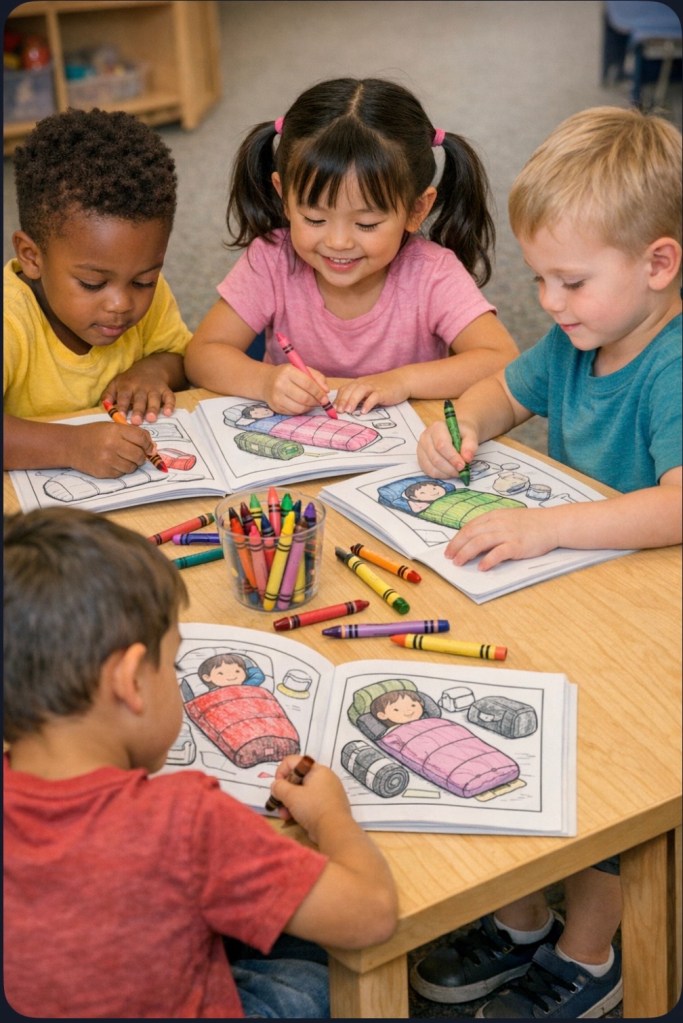
You do not need a curriculum binder, a preparedness seminar, or a weekend workshop to teach your preschooler emergency readiness. You need six activities, some patience, and the willingness to repeat each one until it is automatic.
These six activities cover the most critical preparedness skills for children ages three to five. Together, they address light, shelter, water, identity, calm, and meeting-point navigation — the foundational layer on which everything else in the ABCs curriculum builds. Each one can be introduced in under ten minutes, can be repeated as often as your child enjoys, and requires nothing beyond objects that most families already own.
For each activity, this post provides: a step-by-step guide for the first introduction, variations by age, what to do when a child resists, and the developmental reason why this activity is particularly effective. Read through all six before beginning, then start with whichever one your family needs most right now.
The best preparedness activity is the one you actually do — repeatedly, calmly, and in whatever small window of time your family has available today.
Activity 1: The Flashlight Find
The single most important physical preparedness skill for a young child is knowing where the family flashlight is and being able to retrieve and operate it independently. The Flashlight Find turns that skill into a game that most preschoolers will ask to play again.
The Flashlight Find
How to do it: Step 1: Establish one specific, consistent location for the family emergency flashlight — always in the same spot. Step 2: Show your child the flashlight. Let them hold it, examine it, and turn it on and off. Step 3: Say: ‘This is our emergency flashlight. It always lives right here. Can you find it if I ask you to?’ Step 4: Ask them to close their eyes while you ‘hide’ it in its spot. Then say: ‘Go!’ and time how fast they find it. Celebrate every success. Step 5: Gradually dim the room as they become confident. Eventually, practice in full darkness.
Why it works: Children who have physically retrieved an object multiple times in a low-stakes context will retrieve it automatically in a high-stakes one. This is procedural memory — the kind encoded by the body rather than the mind, which means it persists under stress even when declarative memory (conscious recall) falters.
If your child resists: Never force it. If a child is afraid of the dark, keep the room lit and celebrate finding the flashlight in a well-lit space. The location knowledge is more important than the dark-room practice. Darkness practice can come later, gradually, with the child leading the pace.
Frequency: Play it weekly for the first two months. Then monthly as a maintenance check. Always after replacing the batteries — make the battery replacement a shared activity.
Activity 2: Pack Your Own Go-Bag
Ownership transforms knowledge into commitment. A child who has personally packed their own emergency bag — whose name is on it, who chose some of what goes inside — will reach for it instinctively in a way that a child who merely knows the bag exists will not.
Pack Your Own Go-Bag
Age variations: At age 3, the game is simply finding the flashlight from its visible location. At age 4, add a 30-second timer and make it a personal record attempt. At age 5, ask them to find it and also tell you whether the batteries are still good — teaching simple maintenance alongside location.
How to do it: Step 1: Give your child their own small backpack — ideally one they like and would naturally reach for. Step 2: Sit together and choose five items to put inside. Required items: a full water bottle, a snack (something that keeps), a glow stick, one warm layer. Optional: a small comfort object of their choosing. Step 3: Let them pack it themselves. Let them arrange things inside. Step 4: Label the outside clearly with their name in large print, ideally decorated by the child. Step 5: Store it in a known, consistent location — ideally near the family’s primary go-bag. Step 6: Do a monthly ‘go-bag check’ together: is the water bottle still full? Is the snack still good? Does the glow stick still work?
Why it works: Ownership is a powerful motivator at this developmental stage. A child who has exercised agency in the preparation process has made a personal investment in the outcome. The bag is no longer a parental object they are permitted to use — it is their bag, their responsibility, their contribution to the family’s readiness. That identity shift produces genuine commitment.
If your child resists: If a child is resistant to any specific item, let it go and substitute something they accept. The bag’s existence and location matter more than its precise contents at this age. The comfort object, in particular, is non-negotiable for most children — a familiar object in an unfamiliar situation provides genuine psychological grounding.
Age variations: At age 3, they choose the comfort object and help zip it shut. At age 4, they choose two items (with guidance) and can describe what each one is for. At age 5, they can describe every item and its purpose, and are beginning to think about what they would want if they had to be away from home for one night.
Activity 3: Meeting Spot Practice
Knowing where to go when something goes wrong is the cornerstone of any family emergency plan. For young children, that knowledge must be physically encoded — walked, not described — to be reliable under stress.
Meeting Spot Practice
How to do it: Step 1: Choose your family meeting spot — a specific, named, easy-to-locate outdoor point. A particular tree, the mailbox, the corner stop sign, a neighbor’s lamppost. Make it specific enough that your child could direct someone else to it. Step 2: Walk there together from the front door. Name it out loud together as you walk: ‘This is our meeting spot. If we ever have to leave the house fast, this is where we find each other.’ Step 3: Practice: from inside the front door, on the word ‘go,’ have your child run to the meeting spot. Meet them there. Celebrate. Step 4: Add complexity over time: practice from the back door, from the backyard, from the front yard. Practice in different weather. Practice at different times of day. Step 5: Ask regularly, unprompted: ‘Hey, where is our family meeting spot?’ until the answer comes instantly.
Why it works: Young children learn locations through repeated physical navigation, not verbal description. A child who has walked to the meeting spot twenty times knows it in their body — in the specific combination of turns, landmarks, and distances that make a route automatic. That body knowledge survives panic in a way that verbal recall often does not. When a child is frightened, their working memory narrows dramatically. What remains accessible is automatic, practiced knowledge.
If your child resists: If a child is anxious about the underlying scenario, focus entirely on the game: ‘Let’s see who can get to the oak tree first!’ Never dwell on why the meeting spot matters in a way that elevates the child’s fear. The physical practice is what matters. The emotional framing can stay light.
Age variations: At age 3, walk together every time and celebrate the arrival. At age 4, race to the spot — who gets there first? At age 5, ask them to lead a younger sibling or a stuffed animal to the spot and explain what it is for.
Activity 4: Quiet and Listen
The ability to be still, quiet, and attentive on command is a genuine emergency skill. In any scenario where adults are giving instructions — during a fire evacuation, a shelter-in-place, a community emergency — a child who can override their impulse to move and speak and can instead listen actively is a safer, more responsive child.
Quiet and Listen
How to do it: Step 1: Introduce the game with no preparedness framing at all. ‘I want to play a listening game. When I say Quiet and Listen, everyone freezes and we all listen as hard as we can for 30 seconds. Ready?’ Step 2: Call out ‘Quiet and Listen!’ and model the behavior yourself — freeze, go silent, look attentive. Step 3: After 30 seconds, ask: ‘What did you hear?’ Name the sounds together. Step 4: Gradually increase the duration as the child becomes comfortable — from 30 seconds to 60 seconds to two minutes. Step 5: After the game is well-established as a family practice, introduce the preparedness connection: ‘During an emergency, being quiet and listening for instructions is really important. You are getting so good at it.’
Why it works: Self-regulation — the ability to override an impulse with an intention — is one of the most important executive function skills of early childhood. At the same time, active listening is a survival skill in any scenario where instructions are being given verbally by someone who cannot reach every person physically. A child who has practiced intentional silence many times has both skills available when needed.
If your child resists: Competitive children may resist if they feel they are ‘losing’ by being quiet. Make it cooperative, not competitive: ‘Let’s all be quiet together and see how many sounds we can find.’ Anxious children may resist because stillness feels uncomfortable — keep it very short initially and gradually extend.
Age variations: At age 3, 30 seconds is plenty. Keep it frequent and brief. At age 4, extend to 60 to 90 seconds and ask more specific questions about what they heard. At age 5, add a debriefing: ‘If someone were telling us instructions, could you have heard them just now?’ Connect the skill to its purpose.
Activity 5: Count the Water
Water is the most critical emergency supply and the one most frequently neglected. Making it visible, quantifiable, and cared-for by children creates both a learning outcome and a natural maintenance prompt for parents.
Count the Water
How to do it: Step 1: Take your child to wherever your emergency water is stored. If you do not have emergency water stored yet, this activity is your motivation to start. Step 2: Count the jugs or bottles together. Ask: ‘How many people are in our family?’ Count them on fingers. ‘Each person needs one gallon every day. We have these many jugs. How many days do we have?’ Keep the math simple — the point is the concept, not precision. Step 3: Pick up a jug together. Feel how heavy it is. Talk about what it would feel like to need this water. Step 4: Check the date: ‘Is this water still good?’ If not, replace it together. Step 5: Make this a quarterly ritual — ‘Time to check our water’ — and bring the child every time.
Why it works: Water is abstract until it is physical. A child who has held a gallon jug, counted the family’s supply, and checked a date knows something real and durable about water security. They are also learning quantitative reasoning, basic calendar literacy, and the concept of maintenance — all valuable skills beyond preparedness.
If your child resists: Children who are not interested in counting can simply carry a jug to a new location (building physical awareness of weight and volume) or pour water from the jug into cups. The physical interaction is what matters — the learning happens through the body.
Age variations: At age 3, counting and touching are enough. At age 4, add simple arithmetic: ‘We have 4 jugs and 4 people. That’s one each.’ At age 5, involve them in replacing expired water — measure, pour, refill, re-date. Make them the household water steward.
Activity 6: Three Slow Breaths
This is the simplest activity in the series and the one with the most lasting impact. A child who has a practiced, named, automatic calming technique is physiologically better equipped to handle fear than one who does not. This is not a coping mechanism. It is a skill.
Three Slow Breaths
How to do it: Step 1: Introduce it casually, with no emergency framing. ‘I want to teach you something I do when I feel worried or stressed. It helps my body calm down. Want to try?’ Step 2: Breathe in slowly together for four counts: ‘One… two… three… four.’ Hold for two. Breathe out for four. Step 3: Do it three times. Notice how your body feels different afterward. Step 4: Name it: ‘This is Three Slow Breaths. It’s what we do when we feel scared or worried.’ Step 5: Practice it at low-stakes moments — bedtime, after a frustrating moment, in the car. Make it a family habit, not an emergency-only tool. Step 6: After it is established, use the preparedness connection: ‘In Z for Zero Panic, we learn that being prepared means we don’t panic. Three Slow Breaths is part of that.’
Why it works: Slow, diaphragmatic breathing activates the parasympathetic nervous system, reducing cortisol and adrenaline and improving access to higher cognitive function. A child who is breathing slowly is less overwhelmed, more capable of following instructions, and more able to access memory — including the memory of where the flashlight is, what the meeting spot is called, and what their phone number is. This is neuroscience, applied to a preschooler.
If your child resists: Never make Three Slow Breaths feel like a punishment or a dismissal — ‘Just breathe’ is not empathetic. Model it yourself. Do it with them every time. If they resist, back off and try again another time. The technique only works if the child has chosen to practice it.
Age variations: At age 3, simply breathing together in and out is sufficient — the rhythm matters more than the count. At age 4, add the counting and the hold. At age 5, ask them to teach it to a stuffed animal or a younger sibling — teaching consolidates mastery.
Putting It Together: You do not need to do all six activities before moving on to the full A-to-Z curriculum. Begin with whichever two feel most natural and important for your family. Establish those. Then add the others one at a time. By the time all six are part of your family’s regular routine, your child will already be significantly more prepared than the vast majority of children their age.
NEXT: POST 5
Return HOME
Tags: emergency preparedness activities preschool, flashlight find game, go bag packing kids, family meeting spot practice, quiet and listen game, three slow breaths children, water storage kids, play-based preparedness ages 3-5
Series: Little Learners, Big Preparedness • Post 4 of 7: The Six Core Activities
Post 4 of 7 • Approx. 2,800 words • Audience: Parents and caregivers of children ages 3–5

